Nineteen months, stated plainly — what I have been building, and who it is for.
Every figure below was read off the live system on the day this was written. None of it is estimated.
And nobody has paid me a dollar for any of it yet. That part is further down.
Inside the company the customer has a name. We call him Vernon.
Vernon Guichard was my father, and he was the strongest man I ever knew.
He fixed cars. He did a lot of work for a lot of people in Brooklyn, and he was good at it. He also worked a second job at mass transit, because the car work alone did not carry a household.
I was a child. I did not know what any of this was. There was no word in my house for the thing I have spent nineteen months building, and if there had been, I would not have understood it.
But I understand it now, and here is what I know: my father should not have had to work that second job. He should not have had to fix a man's car for a bottle of rum and twenty dollars. Not because he was too proud for it — because he was good, and being good was not the problem. Being found was the problem, and nobody in 1980-something was going to solve that for a Black man with a toolbox in Brooklyn.
He had every ingredient of a real business except one, and it was the one nobody could sell him.
That is who this is for. Not a demographic. A specific man, who is out there right now under somebody's car or somebody's furnace, doing work that is worth more than he is being paid for it, because the people who need him cannot find him and the people who could find him for a fee are charging him for the privilege every month.
I named the customer after my father on purpose, so that I could not lose sight of who it was for on a bad week.
A contractor in Ohio wrote this on a public forum earlier this year:
"They're frauds, all the leads are fake. They got me for $1,000 in two days."
Another one: "From a contractor perspective, it's an expensive turdfire." A third: "Every call was some super cheap person who does zero maintenance on their systems."
They are all talking about the same thing. Lead services. Companies that sell a plumber the phone number of somebody who might need a plumber. The plumber pays whether the job closes or not, whether the caller was real or not, and whether the same lead was sold to four of his competitors or not.
I have spent nineteen months building the alternative. This letter is what it is, what is actually built, and where it honestly stands.
A contractor has a five-page website. Home, About, Services, Contact, and one page nobody reads. That is five chances for anybody to find him on the internet, and four of them are not about anything a customer would ever search for.
So he buys leads. And the moment he stops paying, he goes back to invisible. He has spent, in some cases, tens of thousands of dollars over a decade and owns nothing at the end of it. Not one page. Not one asset. He was renting his own customers.
Meanwhile the questions his customers actually type into Google — "why does my drain smell", "how much should a water heater cost", "is my roof leak covered" — are being answered by somebody. Usually a national franchise with a content team. Almost never by the man who could actually do the work, four miles away.
That gap is the whole business.
Blog Scoreboard turns a contractor talking for ten minutes into pages that answer those questions, published under his own name, on his own site, that keep working whether he pays next month or not.
He does not write. He does not think of topics. He does not learn anything about search engines. He talks about a job he finished, the way he would explain it standing in a customer's kitchen, and the system does the rest.
That is the product in one paragraph. The rest of this letter is what sits underneath it, because the idea is not the hard part — everybody has had the idea. The hard part is the machinery.
This is the part I would want understood before anything else in this letter, because it is the whole thesis. Everything after it is machinery in service of it.
Ten minutes a day, five days a week, talking about jobs he actually did. Each of those becomes a cluster of pages — his story, and the smaller questions that hang off it. At the end of one year that is roughly fifteen hundred pages on his own website, every one of them answering something a real person actually asks.
The man in the same trade on the other side of town has a beautiful website. Real photography, good graphics, somebody was paid properly to design it. It is five pages. Home, About, Services, Contact, and one nobody reads.
Now think about how a customer actually arrives, because this is the part everybody gets wrong. At three in the morning a woman bites into a piece of steak and her crown comes loose in her mouth. She is not typing "dentist near me." Nobody in that state types "dentist near me." She types what just happened to her — the crown, the loose feeling, whether she can still eat, whether it can wait until Monday, whether this is going to cost her four figures.
One of those two websites has an answer to that question. The other one has a Services page.
Multiply that by every version of every question anybody in his town could think to ask about what he does, at two in the afternoon or three in the morning, and that is what the product actually is. It is not "more content." It is coverage — having already answered everything she could wonder about before she is ready to pick up the phone.
I will not put a promise about search positions in a letter to my own family, and I do not let the product make one either. Nobody controls Google. But there is a part of this that is not opinion and not a promise: at the end of that year, one of those two men has answered fifteen hundred versions of the question and the other has answered none — and the first man owns every one of those answers, on his own site, under his own name, whether he pays us next month or not.
That is what I am selling him. Not marketing. The difference between having an answer and not having one, fifteen hundred times over.
This is how I actually think about it, and it is the closest I can get to why I believe it works. My father was a mechanic, so I think about it mechanically.
Put two Ferraris on a road. Same engine. Same body. Same fuel. Same road. Both cars top out at exactly the same speed. Nobody has the faster car.
The road is Google. The top speed is what Google actually rewards — whether you have really done the work, whether you know the trade, whether anybody knows you exist, and whether you can be trusted. Every business in that town is driving the same car on the same road. Nobody gets a bigger engine.
The blue Ferrari is cruising along at a hundred and fifty. He thinks he is going fast. He has top end left that he has never used and he does not know it.
The red Ferrari comes up the on-ramp, works up through the gears, and opens it all the way. He blows the blue car’s doors off, and he keeps his foot in it, and he makes distance.
Now the blue driver notices. He gets upset. He drops a gear, floors it, and winds all the way up to his own top speed.
And here is the whole thing in one word: matched. Their top speeds are matched. The best the blue car can ever do from here is go exactly as fast as the red car is already going. He can hold the gap. He can never close it. That distance is frozen for as long as they are both on that road.
The only thing that could save the blue driver is the road changing. The road is not going to change.
That is why I do not worry that I am late or small. It was never about being faster than the man across town. Nobody is faster. It is about being the one who gets on the throttle first — and every day he does not, somebody else can.
Google will actually tell you what it rewards, and it has a name for it: experience, expertise, authority and trust. Whether you have really done the work. Whether you know the trade. Whether anybody knows you exist. Whether you can be trusted. That is the top speed of the car, and it is the same for everybody on the road.
What nobody tells a contractor is what it looks like while it is happening to him. So I named that part myself. I call it CMOLE, and it is five letters for the five stages of the climb.
Catch up. Match. Overtake. Lead. Expand the lead.
Those five sit on his board, underneath the chart, and the line he is watching changes colour as it moves through them. Google’s signals run along the top of the same box, because those are the inputs. CMOLE runs along the bottom, because that is what the inputs produce. One is the throttle. The other is the speedometer.
I made it up for one reason. Tell a tradesman "you’ll win" and he shrugs, because everybody has told him that and taken his money for it. Tell him "you are in Match right now, that is the man in front of you, that is the distance, and this is what moves you to Overtake" — and he believes it, because it is mechanical, and mechanical is the language he already speaks. My father was a mechanic. So is every good contractor I have ever met. They do not trust promises. They trust mechanisms.
That is the difference between a scoreboard and a slogan. A slogan tells a man he is going to win. A scoreboard tells him where he is on the road.
Take HVAC, because it is the trade I know best through my own family.
My brother-in-law, Wayne Adolph, was in it. If Wayne were still in the HVAC business today and he decided he wanted to be the one at the top of his market — his niche, his territory, his town — this is the number he would have to beat. Not my opinion of it. The measurement.
From the live system, the operators sitting at the top of the local map in HVAC hold on average:
29.5 articles · 9.5 directory listings · 5 videos · 335.5 reviews · 57.1% of those reviews answered · 99.4% reputation score
Ninety companies stand behind those figures.
That is what it actually takes, stated as a number, for the first time. Wayne would not have to guess, or hire an agency to guess for him, or believe anybody. He would open it, see his own six against those six, and know exactly what was missing and by how much.
That is the entire product in one paragraph, and it is why I built it.
He lands on an article — something about lead services, something he already believes. At the bottom of it there is one line. He taps it, and it becomes a box asking for his website. Nothing else. No form, no sign-up, no credit card.
He types it and hits go. Somebody comes on and talks to him for a minute while, behind that, the system goes out and looks at his business: who he is, what he does, what is already out there under his name, and who is sitting at the top of the map in his town.
Then his own app opens, full screen, already filled in with his business. Not a demo. His.
He can save it to his phone in five seconds. It is free, and it stays free while he looks around. Every number in it is his own, measured, with the honest word "not measured yet" wherever we could not find something rather than a zero pretending to be a fact.
That is the entire sales process. There is no salesman in it.
There are three servers. On two of them, right now, one hundred and fifty seven separate services are running. The third does nothing but carry the mail. Not one program — a hundred and fifty seven of them, each doing one job, watching each other, and reporting when one goes quiet.
Some of them go out and look. They read a business's website the way a customer would see it, and work out who it is, what trade it is in, and what is already out there with its name on it. That harvest has measured 51,250 businesses and holds them on file: their reviews, how many of those reviews they answered, where they are listed, what they have published.
Some of them keep the standard. For 578 trades, the system knows what the operators sitting at the top of the local map actually have — not a theory of what works, a measurement of what the winners are doing. Six things: articles, backlinks, directory listings, videos, reviews, and how fast those reviews get answered. We call it the recipe. A contractor's own six numbers sit next to it, and the difference between them is the job.
Some of them write. But not from nothing, and this is the part I would want an investor to look at hardest.
The reason contractors do not publish is not laziness. It is the blank page. Nobody knows what to write about, so nobody writes anything, and the man who knows the most says the least.
So the system does not ask him to think of anything.
It reads what an entire trade is publishing, across every city we hold — the operators at the top of each map and everybody else in the niche — and watches for the same question surfacing again and again in different towns. When a title turns up in ninety cities, that is not a local quirk. That is something the whole country is asking, and we score it by exactly that: how many places it appears in.
Those are seeds. They were not invented, brainstormed or bought — they were harvested from what is already being asked, and the harvest never stops. New ones surface every day as the trades keep publishing, and the seed bank grows on its own.
A contractor reads his over coffee, puts the phone down and goes to work. Some job during the day reminds him of one. He taps it and talks about what just happened to him.
He never sees his own words on the screen while he talks — only a waveform, so he knows it is listening. That is deliberate. The moment a man sees his own sentences he starts correcting them, and then he is writing instead of talking, and writing is the thing that stops everybody. He stutters, starts over, loses his thread. It gets cleaned up afterwards. Nobody sees the mess.
What comes back is a cluster of pages answering that question six different ways, in his words, off his own job, with his own photographs, stamped with the day he took them.
And a seed is never used up. The same one, six months later off a different job with different photographs, is a different story — because the story was never in the title. It was in what happened to him.
Everybody in this industry sells opinion. "You should blog more." "You need backlinks." Nobody tells a contractor what the number actually is, because nobody has measured it.
So we measured it.
The system goes and finds the businesses already sitting at the top of the local map in a given trade, and counts what they actually have. Not what they say, not best practice — what is really there, on their sites and their profiles, today.
For plumbers, from the live system as this letter was written, the operators at the top hold on average:
44 articles · 10 directory listings · 76.5 videos · 473 reviews · 60.7% of those reviews answered · 97.8% reputation score
Seventy-eight companies stand behind that one trade's figures. Six numbers, measured, not guessed. A contractor's own six sit next to them, and the gap between the two columns is his to-do list — for the first time in plain arithmetic instead of advice.
It is not a snapshot. It runs continuously. As the winners in a town publish more, answer faster, and collect reviews, their averages move, and the target moves with them. A contractor is never chasing last year's standard. 578 trades are loaded and being kept current this way.
That is also why it cannot be copied by reading it. Anyone can see the six numbers. Nobody else has 51,250 businesses on file being re-measured to keep them true.
There is a difference between a system that can talk and a system that knows something, and it is the difference between a novelty and a business.
An industrial corpus is the body of real knowledge for one trade. Not general knowledge about plumbing — the working knowledge: what actually goes wrong, what it costs, what the parts are called, what a customer asks first, what the honest answer is, where the industry disagrees with itself, and what a good operator says when a homeowner is frightened at eleven at night.
We build one per trade, from what the trade itself has published and from what the people in it say to each other. And Sophia is trained on the corpus for the trade she is standing in.
That is the whole difference. A general assistant on a plumber's website is a search box with manners — it knows a little about everything and nothing about his job, and the first real question exposes it. Sophia on that site has read the trade. She knows the difference between a slab leak and a supply line, what a homeowner means when they say the water "smells like eggs", and which of those two calls is the emergency.
The corpus is why she does not have to be told what to say. It is also why the pages the system writes read like a tradesman wrote them, because they were built on the same body of knowledge and then filled with one man's own words about his own job.
One corpus per trade, and a corpus for every trade we enter. Building it is the slow part of opening a new category, and it is the part that cannot be shortcut — which is exactly why it is worth having done.
Sophia is named and built after my sister, Andrea Adolph.
Anybody who knows Andrea knows what she is: the person who takes care of everyone around her, without being asked, as a matter of course. Not a helper. A matriarch. It is not something she does, it is what she is, and everyone in the family arranges themselves around it without ever discussing it.
That is Sophia's character, and character is the right word, not personality. She is not friendly because friendliness converts better. She looks after the contractor's customers because that is her job and that is who she is — including the part where she stops and gets a human when somebody needs one, which a system optimised for engagement would never do.
It is also why her memory is architected the way it is. A matriarch who forgot who you were would not be a matriarch. Somebody who says "I've got your back" and somebody who says "sorry, who are you?" cannot be the same person, and a customer works that out in one conversation.
So when I say her memory is not a feature — it is her character — that is not a slogan. It is the design constraint everything else was built around.
Sophia sits inside the app and on the contractor's own website. She talks to his customers at two in the morning when he is asleep and on a Sunday when he is with his kids. She answers what she can, books what she can, and the moment somebody says they want to speak to a person, she stops and gets him.
Every conversation she has is readable by him. Nothing is hidden, because she works for him, not instead of him. When a conversation starts going the wrong way — or when a customer asks for a human — she raises her hand and he gets a notification that walks him straight into that conversation, past everything else.
She is also the teacher. There is no manual anywhere in this product. Instead there are 114 short videos of a person explaining each thing you can see — what a citation is, what that number means, why reviews from this year outweigh reviews from four years ago. They are cut out of their background and stand on the page next to the thing they are explaining. Tap a number you do not understand, and somebody comes out and tells you.
That was a deliberate decision. The people this is built for do not read documentation. They will watch fifteen seconds.
This is the part I would most like understood, because it is the part people assume they already understand.
A chatbot answers a question and forgets you. It has no history, no stake, and no idea who it is talking to. Every conversation starts from nothing, which is why every one of them feels the same and why nobody trusts them.
Sophia has a memory, and the architecture of that memory is the work. It is compartmentalised — every contractor gets his own, on his own blog, holding only his business, his customers, his history and his conversations. His Sophia is not a shared brain wearing his logo. She does not know another contractor's customers and cannot leak them, because she was never given them.
What she does share is craft. She is trained on how to actually talk to a person under pressure — on Chris Voss on negotiation, Zig Ziglar on selling as service, Dale Carnegie on treating people like people. Not to manipulate anybody. To listen properly, to hear what somebody is actually asking underneath the question they asked, and to know when the honest answer is let me get him for you.
That last one matters more than anything clever she does. The moment a customer says they want a human, she stops and fetches one. A system that will not do that eventually costs its owner a customer, and he will never know which one.
That memory is what makes her worth having on his site at two in the morning rather than a form. She picks a conversation up where it was left, weeks later, and the customer never has to explain himself twice.
This is the piece I would want an investor to sit with longest, because it is the only part of this that gets stronger on its own.
Somebody asks her something genuinely technical and she does not have the answer. Or the customer simply says let me talk to a human. She does not bluff and she does not stall her way through it. She stops, and she goes and fetches Vernon.
Vernon walks into that conversation and answers it the way only a man who does the work can. And while he does, she is standing behind him watching — not only what the answer was, but how he gave it to a worried person at nine at night.
Then that answer does not stay in Spokane.
It goes into the industrial corpus for that trade. So when a dentist’s patient in Miami asks the same question six weeks later, the Sophia standing in that Miami practice already knows it — because a dentist in Spokane taught it to her.
I would ask you to read that twice, because of what it actually means. Every contractor who ever stops to answer a hard question is teaching every other contractor in his trade, in every city, permanently. Nobody has to agree to anything, nobody has to write anything down, and no man loses a thing by it.
And the line between what travels and what never does is drawn hard, because it has to be. His customers’ conversations are his. They sit on his own ground, walled off, never pooled with anybody. What travels is the knowledge of the trade — the answer to "does a loose crown mean the tooth underneath has gone bad", never who asked it, never their name, never their number.
Now look at the shape of it over time. She starts out needing him fairly often, and she needs him less every month, in his trade, everywhere at once. A competitor who buys a chatbot has bought something exactly as clever on day one thousand as it was on day one. This gets harder to stump every single time somebody stumps it.
That is not a feature I can be copied on by somebody writing better software. It is what happens when you have the corpus, the contractors, and a reason for them to keep talking to it — and it takes years, not a sprint.
One more thing about Sophia, because it costs nothing and matters more than it sounds.
She answers in the language of the person in front of her. Her office reads the visitor's own device setting and carries it into every message. A homeowner whose phone is in Spanish gets Spanish, at eleven at night, from the contractor's own website, without that contractor speaking a word of it.
A large share of the American trades is Spanish-speaking on both sides of the counter. Nobody is serving them. She already can.
Everything above happens to be aimed at lead services, because that is where the anger is and anger is easy to find. But that is the first category, not the business.
The business is this: write honest reviews of everything a tradesman spends money on.
He buys software to run his jobs. He buys tools. He buys insurance. He buys a truck — and he does not buy one truck, he researches for weeks and then buys another one three years later. Every one of those purchases starts the same way: a man sitting in his van at nine at night, typing a comparison into his phone.
So there will be a category on field service software, and one on the machines each trade actually uses, and one on heavy-duty work trucks, and one on every other thing a man in a trade reaches for his cash or his credit to buy.
The article does its job honestly — a real comparison, useful whether or not he ever hears of us. And the same door sits at the bottom of every one of them.
That is why the shell had to be built before the categories. One shell, any filling. A contractor who has read one of these already knows how to hold the next one, whether it was about lead services or about a three-quarter-ton truck.
There is one more piece, and it was built before most of the rest of it, because there is no point owning a machine that finds the right man if you have no way to reach him.
We call it the Cannon. It is the outbound side.
It holds 56,719 businesses with verified contact details, across 846 trade categories and 2,262 towns and cities. Every one of them was gathered, verified, and de-duplicated by the system itself — not bought as a list, which is why the addresses are real and why the same man does not appear four times under three spellings of his own company.
Nine separate services run it. They handle the sending accounts, the warm-up, the verification, the throttling, and the record of who has been contacted and when.
And that number is not a ceiling, it is a starting balance. As it stands the harvesting side is built to bring in five thousand new businesses a day, gathered and verified the same way. It is deliberately idling. I have it turned down to almost nothing right now, because I already hold more names than I can responsibly write to at one message per man per day, and there is no sense collecting people I am not ready to talk to. The point is that when the writing side is running at volume and the list needs to grow, growing it is a dial I turn, not a thing I have to go and build.
And it is deliberately restrained. One message per man per day is the hard ceiling, no matter what the machinery could do — because the fastest way to destroy an email operation is to let it run at the speed it is capable of. It manages itself; I hold one dial.
Two different ceilings hold it, and they hold different things. One message per man per day is the one that protects the person receiving it — whatever the machinery could do, nobody hears from me twice in a day. Twenty five a day per sending address is the one that protects the rail itself, and it is written into the code as a hard clamp, applied last, after every other calculation, so no ramp setting and no arithmetic mistake can push a mailbox past it.
Three hundred addresses at that ceiling is seven and a half thousand messages a day, sent one per person, from real addresses that can be replied to. That is the top of the ramp, not today — today the ramp is switched off at the source and the addresses are still warming, because a new sending domain that opens at full speed is a domain that gets itself blocked in a week. It climbs to that number over months, or it does not get there at all.
Here is why it matters more than it sounds. The same 51,250 businesses the system measures are the businesses the Cannon can reach. So when the measuring finds a man whose numbers have just slipped, we are not hoping to bump into him. We already hold his details, we know his trade, we know his town, and we know exactly what went wrong for him this month.
That is the whole loop, and it is closed: measure them, watch them, know when something changes, and be able to reach that specific man about that specific thing on that specific day.
Most companies in this space buy a list and shout at it. This one built the list as a by-product of building the product, and every name in it comes with a measurement attached.
The Cannon started on rented ground. A couple of hundred Gmail accounts, warmed up properly, sending a handful of messages each a day. It worked, and then it started not working.
The problem with rented accounts is that they are rented. Somebody else decides how many you may send, whether this one is still allowed to exist, and whether you get told before it stops. There is no appeal and there is nobody to call. I would build a sending fleet up over weeks and then watch pieces of it go dark for reasons nobody would ever explain to me. I still hold those accounts today — two hundred and fifty five of them, two hundred and twenty nine of them healthy, the rest degraded or gone — and I still use them. But I stopped being willing to have the outbound side of my company sit on somebody else’s permission.
So I built my own. That is the third server, and it does nothing else.
Five domains I own. Three hundred mailboxes on them, sixty on each. Every one of them can send and receive — a real address, not a spoofed sending identity, so when a contractor hits reply the message comes back to me. The signing keys that prove those messages are genuinely mine are published in the world’s DNS, and the whole identity — keys, mailboxes, configuration — is backed up encrypted and restore-tested every single day. This morning’s test decrypted the archive, rebuilt it, and checked every private key against what the world can see. All five matched.
Nobody can take that away from me. There is no account to suspend, no policy to change, no support queue to sit in. If somebody decided tomorrow that they did not care for what I am doing, the rail keeps running, because it is mine.
That is the same instinct as everything else in here, and it is the one I would want an investor to notice: own the thing you depend on. The servers are mine. The addresses are mine. The measurements are mine, gathered by my own machines rather than bought from a data broker who can raise the price or close the tap. The contractor’s pages are his, and he keeps them if he leaves me. It is the same rule pointed in every direction, and it is the reason a bad month somewhere else cannot take this business off the road.
There is a second application that only I hold. From it, on a handset, I have control of the entire system.
Every one of the hundred and fifty seven services and whether it is alive. Every article, every draft, every word before it goes out. The harvesters and what they pulled overnight. The mail rails. The money. Every conversation Sophia has had. Every script behind every video in the product, editable in place. What the machine cost me to run yesterday.
There is no part of this architecture I am blind to, and that was built on purpose from the first month, because a system you cannot see is a system that is quietly lying to you. Every gauge in it is built so that it can say UNKNOWN rather than show a comfortable number it cannot stand behind.
I mention it because it is the difference between a business and a hobby. I can run this from a phone, from anywhere, and I have been doing exactly that.
It is locked, and only to me. Face ID on my own handset, nothing else gets in.
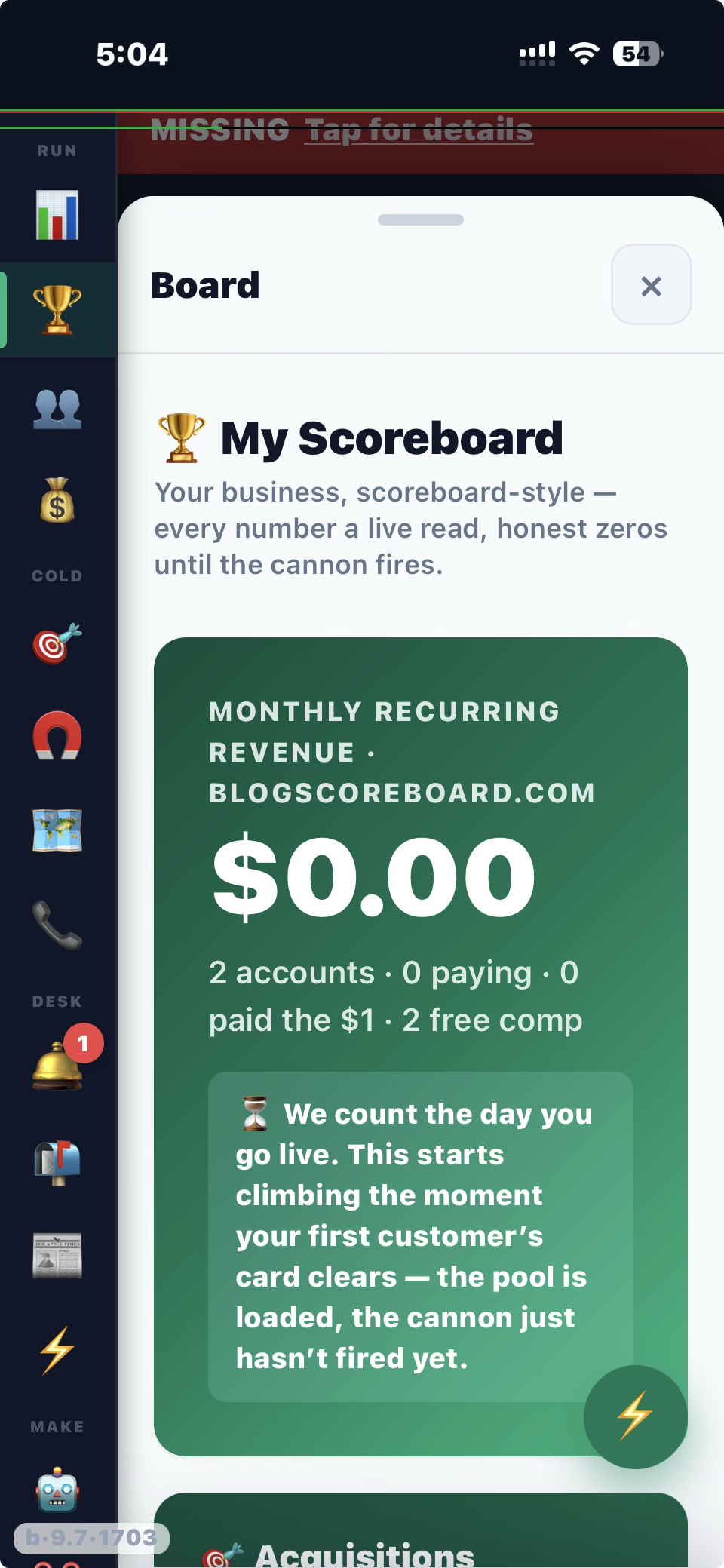
The money board, reading what it actually is today: zero. It will not show me a comfortable number it cannot stand behind.
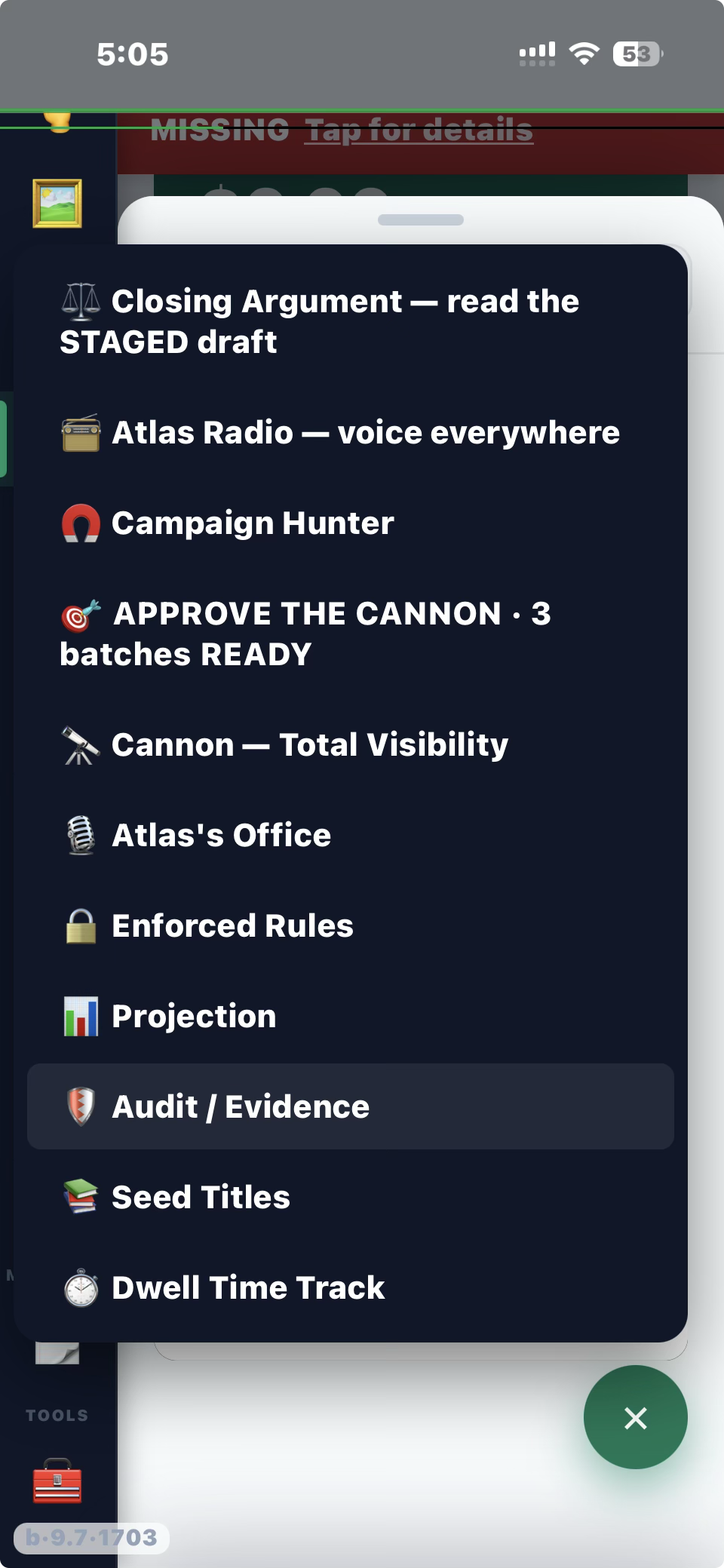
Some of the rooms behind it. Nothing goes out of this building without passing through one of them.
Those three are from my own phone, taken while this letter was being written. The middle one is the part I would point at: it says zero dollars, two accounts, nobody paying — and a red strip across the top telling me something is missing. That is the system doing its job. I would rather be shown the truth every morning than a dashboard that flatters me.
The blog is the salesman. That is the whole strategy and it is the reason the machinery had to come first.
Every article the system publishes carries the app inside it. A contractor searching for something he already worries about — whether a lead service is worth it, what a competitor is doing, what a job should cost — lands on a page that answers his question honestly. At the bottom of that page is one line. He taps it, types his website, and thirty seconds later he is holding his own scoreboard.
He was never sold to. He was answered, and then shown himself.
That means the same engine that serves the customer also acquires him. Every post is a permanent salesman that does not take a salary and does not stop working when the advertising budget does. Paid acquisition is a tap that turns off. This does not.
The twelve-month target is between two and three hundred of those pages live, each one a separate door, each one carrying the app. That is roughly one story per working day, and the arithmetic is not ambitious — it is what the machine already does when it is fed. From there it accelerates, because the pages do not expire and next year's posts are added to this year's, not instead of them.
Today there is a human step: research is gathered by hand and pasted in. That is the last manual link in the chain and it is the one being closed now.
The pieces are already in place. The system knows what to write about, because it harvests the questions being asked across every city in a trade. It knows what good looks like, because it measures the operators at the top of each market. It knows what has already been said, so it does not repeat itself. What remains is joining those to the generator without a person in the middle, and that is engineering, not invention.
When it closes, the cost of the next article is the cost of the compute, and the cost of the next hundred is a hundred times a number measured in cents.
The articles are the machine, and I do not want to undersell them: a page that answers the exact question somebody types at three in the morning is the whole business, and it goes on working for years. But every one of those people had to be looking for something first. There is a second audience that is not searching for anything at all, and reaching them costs us almost nothing extra.
So every article the system makes also becomes short videos, thirty to sixty seconds each, and every one of them points back to that article.
Here is why that matters, put as plainly as I can. Nobody wakes up wanting to read about drain cameras. But an enormous number of people are lying on the couch scrolling, not looking for anything in particular. A short video does not wait to be searched for — it gets pushed in front of people while they scroll. If it is interesting for thirty seconds, they tap the link, and the link lands them on the article. And the article, as I said earlier, is carrying the app inside it.
Two more things about it that I would want understood. YouTube is the second largest search engine in the world after Google, and it is owned by Google — so a video answering the same question the article answers is a second listing for the same work, on a second search engine, with a second audience. And a short is permanent in the same way a page is. It does not stop working on Friday like an advert does. Every one of them is another door, and we own all of them.
The work is already done twice over by then: the question was harvested, the contractor already talked about it, and the article is already written. The video costs almost nothing more, because it is the same story cut short.
The machinery for it is built and standing — the clip pipeline, the queue, the scheduler that drips them out so a channel never looks like a spam account. It is deliberately locked and has not published its first batch, for the same reason the Cannon is idling: it is waiting on the volume of articles, not the other way round.
The end state is short to describe and it is close.
A category goes in one end — dental, roofing, field service software, heavy trucks. Out the other end come the articles, continuously, without a person in the middle. Google indexes them. They start bringing people in. Each one carries the app.
A contractor lands on a page that answered his actual question. He taps one line. Thirty seconds later he is holding his own scoreboard with his own numbers in it.
Many will try it for free. Some will pay a dollar to see the rest. Some will put a card on file and stay.
And here is the part I would want an investor to sit with: the ones who do not buy keep the app anyway. Free, on their phone, permanently.
Which means every single one of them is carrying a live, honest picture of the distance between where they stand and the man at the top of their map who is eating their lunch. It updates without them. It does not nag, and it does not need to.
That is not a lost lead. That is a customer with a timer on him — and the moment his numbers slip further, the system already knows, and there is a representative who can pick up a phone about it.
Nothing else in this market does that, because nothing else in this market is measuring anybody.
The floor product is under a hundred a month. It gets a contractor found and gives him pages he owns.
The moment that is working, he has a new problem, and it is a good one: work coming in that he now has to organise. Quotes, follow-ups, the customer who called at eleven at night, the job that needs booking.
That is the second floor, and it already has a name. BOSS — the Business Operating System by Sophia. Four hundred and ninety nine dollars a month.
Everything a man running a trade actually needs to run it, in one place. A drag-and-drop website builder, so he is never again held hostage by whoever built his site and stopped answering the phone. A phone system. Text messaging. And the customer record sitting under all of it — who called, what was said, what was quoted, what was booked, what was invoiced, and the review asked for afterwards. With Sophia running it: the same Sophia who is already talking to his customers.
There is plenty of software that does that list, and some of it is good. But every one of them starts from the same place: you bring the customers, and we will help you keep them organised.
This one brings the customers. It goes and gets him found first, and then it runs the work that comes in. That is the sentence nobody else in that category can say honestly, and it is the only reason to build another one of these at all.
I am not going to tell you it is finished, because this letter does not do that anywhere else and I am not starting now. BOSS is the next phase, and it is the phase where I stop being able to do all of it with one pair of hands.
I have already identified two developers in Pakistan that I want to bring onto my team to build it with me. Not an agency, not strangers off a marketplace — two specific people I have found, on the team, working on BOSS while I keep the floor running and the writing machine fed.
If anybody reading this wants a part in that, the door is open and it is entirely their decision. I am not asking, and nobody should feel asked. I would rather say it plainly than leave it hanging: BOSS is getting built either way. Help makes it faster. Nothing about it makes it optional.
The under-a-hundred product is the wedge. It is what gets a contractor through the door — cheap enough to try without a meeting, useful enough that he does not cancel.
At one hundred subscribers, BOSS rolls out. That number is not arbitrary. A hundred paying contractors on the floor product is what carries the two developers and the machinery underneath them — which means the second floor is paid for by the first one, out of revenue, rather than out of anybody’s chequebook.
And it is never sold as a CRM, because nobody on earth wants another CRM. It is sold as what it is: the thing that brings the work in and then runs it.
At the same moment, a third thing rolls out — and this is the piece I have not ruled on yet, so I will describe it as what it is: the strongest idea in this letter and the one I am still turning over.
The system already measures 51,250 businesses and holds their numbers on file. It does not do that once. It watches them.
When one of those businesses takes a turn for the worse — reviews stop coming, the ones that arrive go unanswered, listings drift out of date, a competitor pulls ahead in their town — the system sees it. Nobody else does, including the owner, who is under a sink and not looking.
That is not a lead. That is a lead with timing, and timing is the entire difference between a cold call and a welcome one. A man being told "you slipped off the first page for the thing you do" the week it happened is being done a favour. The same man in a random month is being sold to.
Fifty one thousand of those are already on file, being watched, for nothing, because the measuring had to exist for the product anyway.
The reps. Alongside the BOSS launch I intend to open a representative programme — a phone-first app, so a rep can work from anywhere in the world with nothing but a handset. They are served those signals as they surface, on a dialer, with the business's own numbers already on the screen in front of them.
They are not cold calling. They are calling a specific man about a specific thing that has just happened to his specific business, holding the measurements to prove it, offering the product that fixes exactly that.
I have not decided the shape of it — the commission model, how many, how they are trained, whether it comes at 100 subscribers or later. I am putting it in this letter because it is the answer to the obvious question about a business like this, which is: how do you sell it at scale without a sales floor and a marketing budget?
The answer is that the machine that serves the customer is also the machine that finds him, and it has been quietly building that list for nineteen months.
The contractor brings his own key to the provider that does the generating. That means he is the customer of that provider, not me. I never touch his bill, never mark it up, and cannot spend on his behalf without it appearing on his own screen.
Measured, not estimated: a full cluster of six articles costs him about fifteen cents in compute. If he talks to it every weekday for a month, that is under five dollars. The subscription sits on top of that, and it is under a hundred a month.
Everybody else in this market buys the compute, adds their margin, and buries it in a monthly figure the customer never sees. Taking it out is why this can be sold at this price at all. It is also why a customer can leave and take everything with him, which I would rather be true than pretend.
I asked this question honestly and I am going to answer it honestly, including the part that does not flatter me.
What would it cost somebody to build this from scratch?
Five or six good engineers for twelve to eighteen months — a lead, two on the back end, one on the front, somebody for the data. In the United States that is somewhere between eight hundred thousand and one and a half million dollars. Offshore, two hundred and fifty to four hundred and fifty thousand.
That is only the code. It does not buy the nineteen months of knowing which thing to build, and a team of strangers would build the wrong thing beautifully, because none of them has ever stood in a customer's kitchen explaining a trade.
What is it worth to sell today?
Close to nothing to most buyers, and I want that said plainly. A buyer pays for revenue, and there is no revenue yet. To the right strategic buyer — an agency group, a franchise network, a software company that wants the machinery and the data rather than the name on it — somewhere between fifty and two hundred and fifty thousand. Negotiated, not calculated.
Those two numbers are not the same thing and it matters. What it costs to rebuild is what makes it hard to compete with. It is not what somebody pays for it.
And here is the number that actually matters.
One hundred contractors at ninety nine dollars a month is $118,800 a year. A business like that sells for three to eight times that — three hundred and fifty thousand to nine hundred and fifty thousand.
The same hundred, once BOSS exists at four hundred and ninety nine a month, is $598,800 a year, and that sells for one and a half to four and a half million.
So the distance between where this sits today and where it is worth real money is not more building on the floor — the floor is built. It is one hundred customers. That is the whole gap, and it is the only thing left that I have not done.
I am telling you this because I would rather you knew the real shape of it than thought I was being modest or thought I was exaggerating. It is a machine that would cost a million dollars to build again, sitting at zero, one hundred customers away from being worth what it should be.
And one more thing, which is the part I would actually like you to sit with. That eight hundred thousand to a million and a half assumes a company, an office, and five or six engineers on salary for a year and a half.
I did it on a busted laptop, on a balcony, in Thailand.
I am not going to dress this up.
Built and running: the harvesting, the measurement of 51,250 businesses, the recipe across 578 trades, the generation, the app, Sophia, the teaching layer, the whole intake flow end to end. Yesterday a business nobody had ever entered was typed in cold and the system pulled its name, its town, its trade, its numbers, and the operator above it, in under thirty seconds, on a phone.
Not yet: a paying customer. Not one.
That is the honest position after nineteen months, and I would rather you hear it from me in the first letter than go looking for it. It is also the easiest thing in the world to say about me, so let me say it first and say it properly: I have not made a dollar yet.
But there is a difference between a man who opened the doors and nobody came, and a man who has not opened the doors. I have not opened the doors. I have been building the thing that goes behind them, on purpose, because a machine that fails in front of a paying customer costs you that customer forever, and there are only so many first impressions in a town. Zero revenue after nineteen months of selling would be a verdict. Zero revenue after nineteen months of building is a start date.
What I would say about it is this. The expensive, slow, uncertain part of a business like this is the machinery — the harvesting, the measurement, the standard to measure against, the pipeline that turns a man talking into published pages. That is done and it works. The part that remains is the part everybody can see and judge: selling it.
There are, in the United States alone, hundreds of thousands of contractors currently renting their visibility from somebody else, and every one of them is one cancelled subscription away from invisible. They know it. Read any trade forum for ten minutes.
Nobody has offered them the other thing — not leads, but ownership — in a form that takes ten minutes a day and does not require them to become writers.
The system does not care which trade it points at. The same machinery that measures plumbers measures dentists, roofers, med spas, restaurants. 578 of them are already loaded.
And there is a second floor above this one. Once a contractor is inside and it is working, the natural next thing he needs is the software to run the work the pages bring him. That is a bigger sale to a customer who is already there and already trusts it. I am not building that until the first floor holds people.
Two are published and on Amazon:
Sick of Winning — about the man who does everything right and still has to buy his own customers back every month.
Cracking the Matrix — the first of a two-book series, about building a record so real that being chosen stops being the point.
Blog Scoreboard is those two books, alive. Not a theory any more. A working machine.
Two more are written and unpublished.
Governance vs Continuity — on the tension between keeping a system under control and keeping it running, which is the problem underneath every automated business anybody has ever built.
She Remembers — which is about Sophia, and is the one I would point a technical reader at first.
Descriptions of writing are worth nothing. Here is a cluster the system produced for a dental practice — one question a patient panics about at eleven at night, answered five different ways so that whichever way she phrases it, she finds the same practice:
blogscoreboard.com/blog/dental
Read one of them. Then consider that the dentist did not write it, did not think of the subject, and did not learn anything about search engines to get it. He talked.
Not for money. For twenty minutes.
Walk the whole thing. Not skim it — walk it. Open the link at the bottom, put a real business into it, wait while Nathan talks to you, and watch your own app come up. Look around it. Tap the things you do not understand and let somebody come out and explain them.
Then sign up for the dollar.
I am asking you to do that specifically, and not because I need the dollar. I need to see somebody who is not me come through that whole path — the crawl, the app, the card, the account — and land in the system on the other side. You would be the first person on earth to do it.
And if anything trips you up, take a screenshot and send it to me. Anything. A button that does nothing. A word you did not understand. A moment where you were not sure what to do next. A page that looked wrong on your phone.
I am not going to ask my own family to put a card into something without telling them exactly what it does, so here it is.
It is one dollar, once. Nothing renews. It is not a trial, there is no clock running, and there is nothing you have to remember to cancel. This is the wording that appears on the payment page itself, and it is not marketing copy, it is what the system actually does:
“This is a one-time $1 charge. We keep your card on file so you can turn the service on later with one tap — it will never be charged again unless you choose to. There is no trial clock and nothing renews on its own.”
Your card stays on file only so that the day you ever wanted to switch it on, it is one tap instead of another form. The ninety nine dollars a month is a completely separate, deliberate act that you would have to go and do on purpose. It cannot happen to you by accident and it cannot happen to you by forgetting.
So there is nothing to cancel afterwards, and I am not refunding anybody. Keep the account. If you still have it next week you might notice something I need to know about.
I mean this literally and it is the most useful thing you can give me. You are the first people to ever touch this. Every place you get stuck is a place a contractor would get stuck, and he will not send me a screenshot — he will just close it and I will never know why.
So do not be polite about it. If it is confusing, tell me it is confusing. That is worth more to me than anybody telling me it looks great.
I have tried to explain this to people I love several times and watched their eyes go. That is my failure, not theirs — I go straight to the machinery because that is where I have been living.
So this time, instead of explaining it: it is right here. Type a business you know into it. Watch it come back with things about them you did not know, in half a minute, on your phone.
Nineteen months. Three servers, a hundred and fifty seven services, fifty one thousand businesses measured, and a machine that turns a man talking in his van into something he owns.
That is what I have been doing.
— Ezekiel
Do not take my word for any of this. Put a real business into it and watch.
On the next screen there is one box at the bottom. Type a website into it and press go. That is the whole thing.
Use 15sewer.com — a real plumbing company in San Jose — or, better, any business you actually know. Your own. A friend's. The company that fixed your roof.
You will not be left staring at a spinner. A man called Nathan comes on and talks to you while it works, and the app opens when he is done. It is genuinely going out and looking at that business the whole time he is speaking.
Every figure in this letter was read off the live system on the day it was written. Nothing in it is estimated or rounded in my favour.